The art you share with your community, documented.
Title manages the data behind art and collectible collections, so their owners can manage their financial affairs. For collectors who share their art with their community, we turn that record into a digital showroom of their engagement, a Social Impact Report they can use for their own ESG metrics, and a one-page summary to share publicly.
Talk to us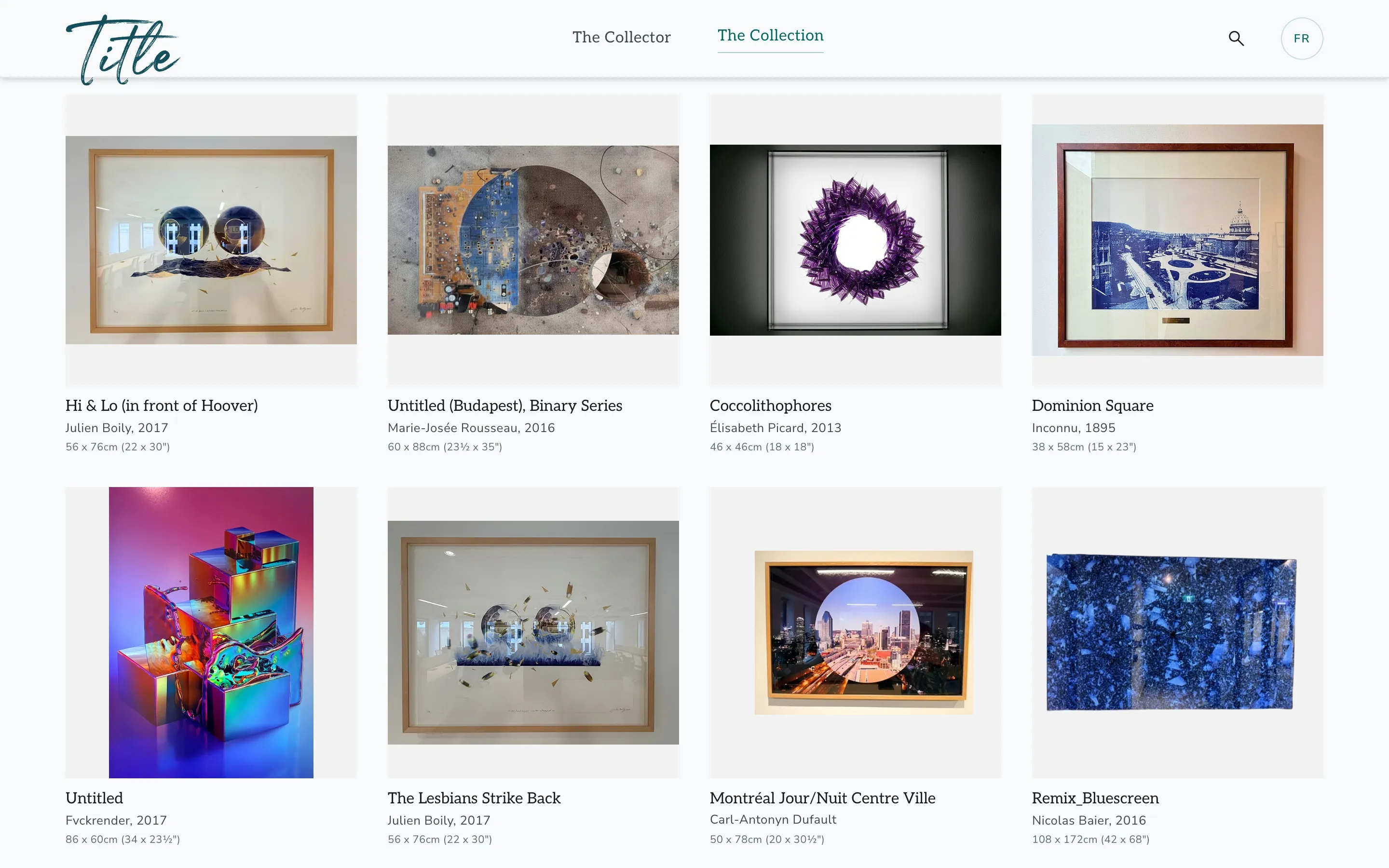
Three parts, one record.
A digital showroom
A bilingual (French and English) page for each work, public or private, reached from a QR code beside the work. Visit counts per page, including visits through tracked links.
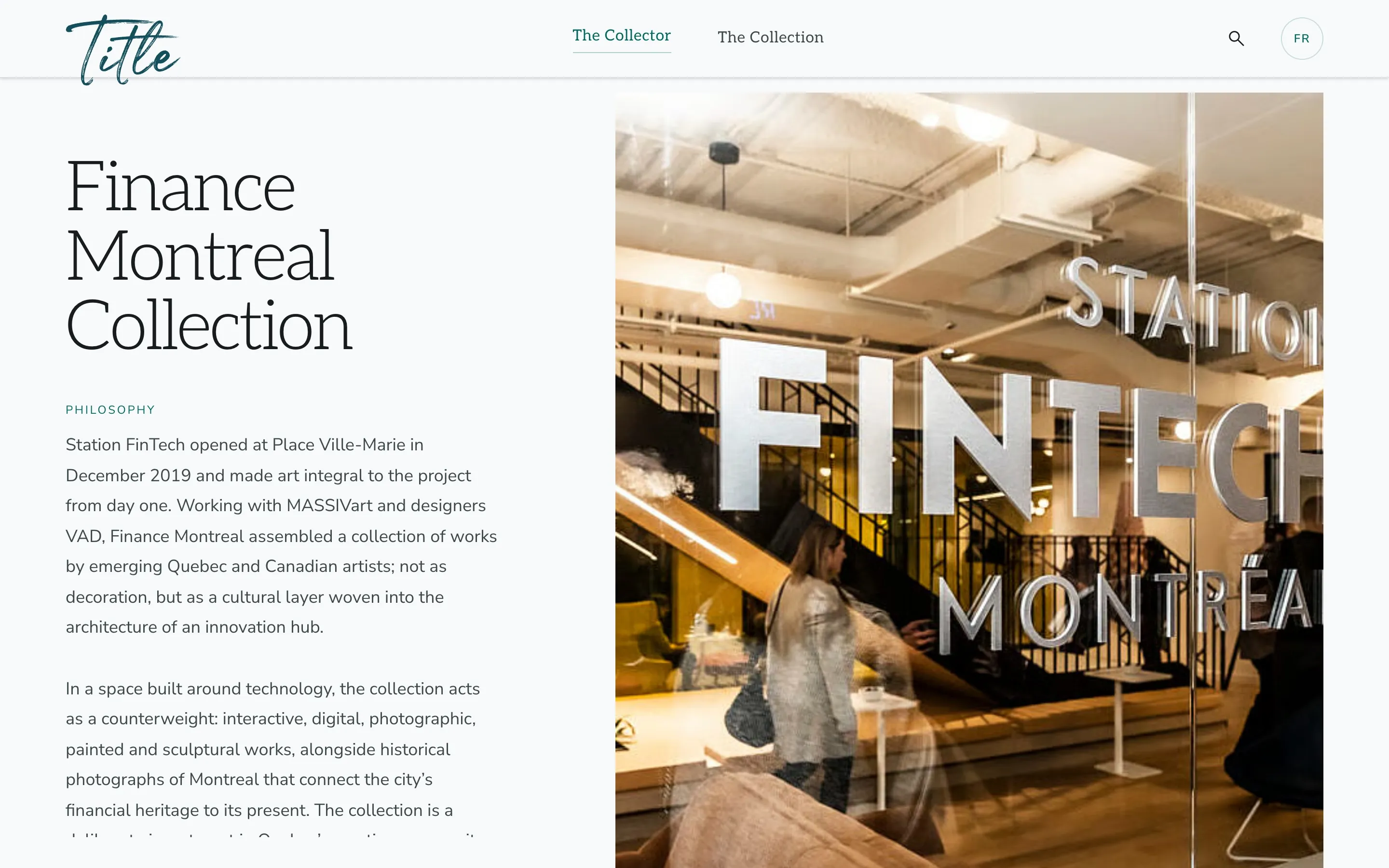
A Social Impact Report
The collection's data in full, strengths and gaps alike, every figure with its base and source. No score, rating or points.
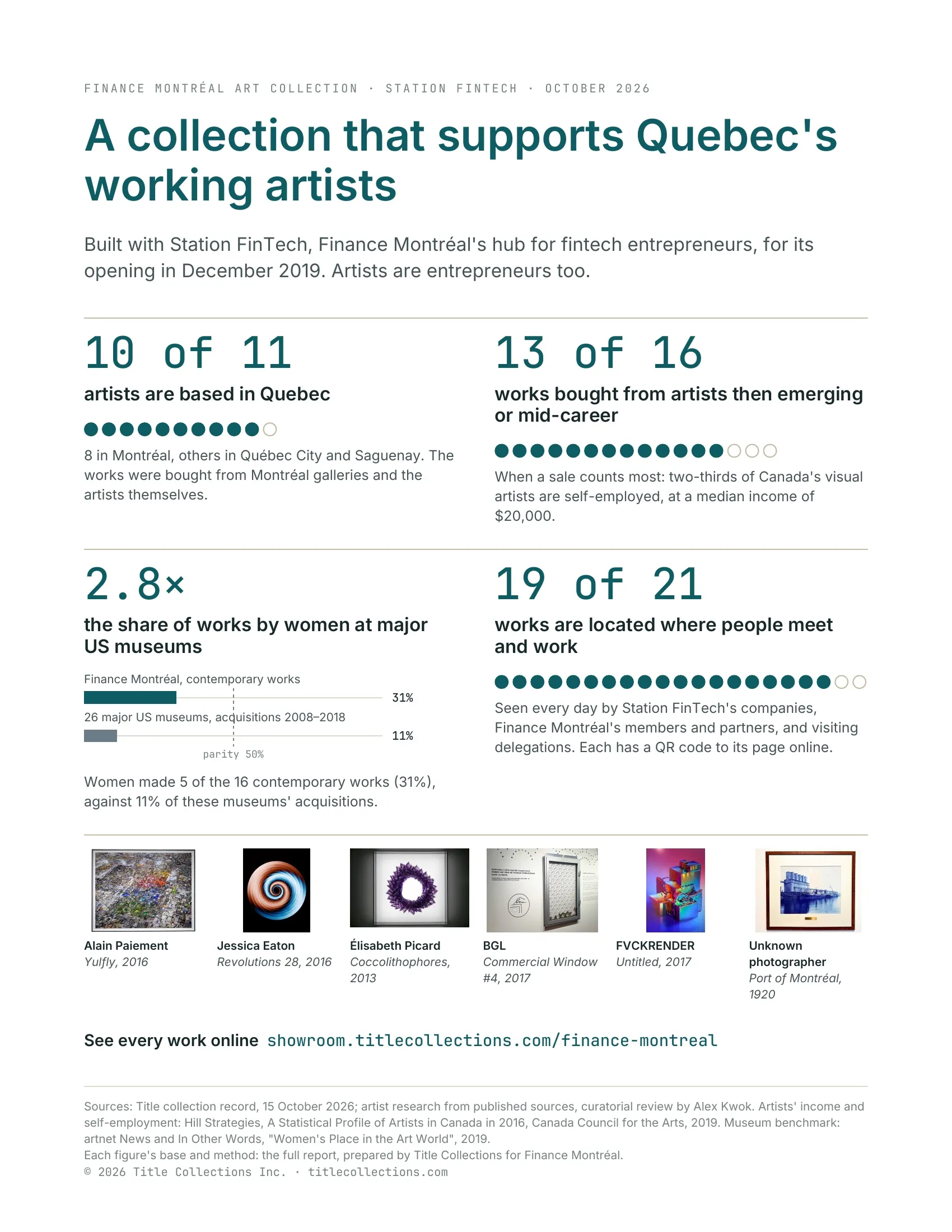
A one-page summary
A page the collector can share publicly, showing only the figures it has approved in writing.
What the record holds.
Per work
- The artist, as documented in published sources, and where the artist is based.
- Where the work is located, and since when, with a photograph in place.
- How it was acquired, from whom and at what cost.
- Who can see it, including visits to its showroom page.
What the record can supply, standard by standard.
We never say a collection “aligns with”, “maps to” or “complies with” a standard. For each standard, this is the exact item, what the record can supply, the condition, and who decides.
| Standard and item | What the record can supply | Condition | Who decides |
|---|---|---|---|
| GRI 201-1, community investments | The direct costs of the organization's art programs with external beneficiaries, compiled from its program records, as an input. GRI 201 guidance does not list the purchase of artwork among its examples. | Reports 201-1 and runs such a program | The organization and its accountants |
| GRI 204-1, local suppliers | Art spend in a period by supplier location, compiled from its purchase records, as an input to its own percentage | Reports 204-1, and its procurement budget includes art purchases | The organization and its accountants |
| WELL v2, M02.2 | Evidence for the “Integration of art.” element and, where the record documents it, “Celebration of culture” and “Celebration of place” | The project is enrolled to pursue WELL Certification or WELL Core Certification | GBCI's verification |
| BOMA BEST 4.1, question A3.3 | A description and photographs, as part of the documentation A3.3 asks for | Owns or manages the building; a tenant's works in the building's common areas, for its landlord to cite | BOMA BEST verification |
| Fitwel®, Appealing and Accessible Stair | Annotated photographs of works in the stairs; art is one of six features and two are needed | Certifies its own space under the Commercial Interior scorecard, with a connecting stair | Fitwel's review |
What we never claim
- Points, credits, scores or ratings for a collection.
- That collection statistics are GRI disclosures. Artist gender is a collection statistic; GRI 405 covers the organization's governance bodies and employees.
- Anything under the UN Sustainable Development Goals, GRESB, GRI 203 or GRI 413.
How it works.
- 01
Intake
Scope, the question the organization wants answered, access.
- 02
Record
Each work catalogued; artists researched from published sources, reviewed by our curator.
- 03
Report
The report and the draft one-page summary, checked figure by figure.
- 04
Share
The showroom, and the summary once approved; then yearly updates.
Who it is for.
Organizations that own a collection of 15 works or more and either report on ESG or show community or cultural engagement they want to share (art shown to clients and visitors, events, cultural sponsorships, a foundation or community program).
Owning or leasing their premises makes no difference; a building certification only adds certification evidence.
The first mandate.

Our first mandate is a living-lab agreement with Finance Montréal.
Visit the Finance Montréal showroom →Team.

George Fortin, MBA
Managing Director & Founder
Over two decades in institutional finance. As an Investment Manager in real estate private equity at PSP Investments, managed multi-billion-dollar assets and led large-scale ESG initiatives. Lloyd's Lab alumnus; MBA, Rotman.
LinkedIn →
Alex Kwok, MFA
Director of Collection Management & Operations
Former Associate Curator, Registry and Collection Management at TD Bank, where he managed one of Canada's largest corporate art collections (6,000+ works). Over a decade in art collections and operations; MFA, Parsons.
LinkedIn →
Talk to us.
Send a request and we come back to you. Or on his calendar.